


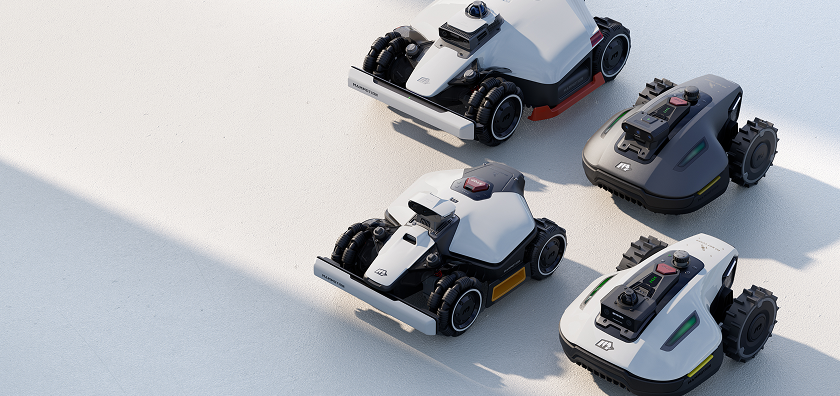
With the introduction of YUKA mini 2 1000 in 2026, Mammotion brings upgraded navigation and perception technology to the lineup. Compared with YUKA mini, the new model features enhanced 360° LiDAR-assisted navigation and improved environmental awareness, helping it perform more consistently in complex outdoor spaces such as tree-covered lawns, narrow pathways, and partially shaded areas.
In this guide, we’ll compare YUKA mini and YUKA mini 2 across navigation technology, mapping experience, obstacle detection, lawn coverage, and newly introduced features to help you choose the right robot lawn mower for your yard.
YUKA mini 2 vs. YUKA mini: Quick Comparison Table
|
Feature |
||
|
Model |
600 / 800 |
1000 |
|
Max. Lawn Size |
600㎡ / 800㎡ |
1000㎡ |
|
Navigation System |
NetRTK + Dual Camera AI Vision |
360° LiDAR + Dual-Camera AI Vision |
|
Climbing Ability |
50% (27°) |
45%(24°) |
|
Cutting Width |
190 mm |
190 mm |
|
Cutting Height |
20-60 mm |
20-60 mm |
|
Battery Capacity |
2.4 Ah / 6.1 Ah |
6.1Ah |
|
Mowing area |
100 ㎡/per charge 200 ㎡/per charge |
250㎡ per charge |
|
Mowing time per charge |
55min / 150min |
125min |
|
Obstacle Detection |
AI Vision |
LiDAR + AI Vision |
YUKA mini 2 vs. YUKA mini: Key Differences Explained
While YUKA mini and YUKA mini 2 1000 share the same core purpose of delivering autonomous, wire-free lawn mowing for residential users, they are built on different navigation and sensing foundations. These differences directly influence how each model performs in various lawn environments, especially in terms of positioning accuracy, terrain adaptability, and overall operational stability.
Below is a breakdown of the key technical differences and what they mean in real-world use.
2. Intelligence and Obstacle Detection
Both YUKA mini and YUKA mini 2 1000 use AI Vision systems to support obstacle detection and environmental understanding during mowing. However, the two models differ significantly in their onboard processing capability and recognition scope.
YUKA mini
YUKA mini relies on AI Vision-based obstacle detection, enabling the mower to recognize and react to common objects found in residential garden environments.
YUKA mini supports recognition of 200+ object types, covering typical outdoor obstacles encountered during operation.
YUKA mini 2 1000
YUKA mini 2 1000 upgrades both hardware and perception capability.
It features a 10 TOPS AI chip, which enhances onboard processing power for real-time perception tasks. Combined with LiDAR + AI Vision, the system improves environmental sensing and spatial awareness during operation.
In terms of obstacle recognition, YUKA mini 2 1000 supports 300+ object types, expanding the range of detectable and classifiable obstacles compared to the previous generation.

4. Efficiency and Coverage
Both YUKA mini and YUKA mini 2 1000 are designed to operate efficiently within residential lawn environments, with performance varying based on battery configuration and mowing conditions.
YUKA mini
YUKA mini 600/800 offers different performance depending on battery configuration:
- Max. Coverage: 600㎡ / 800㎡
- Mowing area per charge: 100㎡ / 200㎡
- Mowing time per charge: 55 min / 150 min
These values reflect the different configurations available within the YUKA mini lineup.
YUKA mini 2 1000
YUKA mini 2 1000 provides:
- Max. Coverage: 1000㎡
- Mowing area per charge: 250㎡
- Mowing time per charge: 125 min

5. What’s New in YUKA mini 2
YUKA mini 2 1000 introduces several new software and system-level features designed to improve usability, flexibility, and sustainability in everyday lawn care.
These features focus less on core mowing hardware and more on how users interact with the mower in daily operation.
Smart Battery System
YUKA mini 2 1000 introduces a Smart Battery System that allows users to manage charging behavior more intelligently.
- Custom charging limits (e.g., setting maximum charge to 80%) to help extend battery lifespan
- Smart Mode, where the mower maintains a storage charge and only fully charges before the next scheduled task
- Off-Peak Charging, allowing users to schedule charging during lower electricity cost hours
This system focuses on improving battery management flexibility and long-term efficiency.
DropMow
YUKA mini 2 1000 supports a feature called DropMow, designed for quick or temporary mowing tasks.
This mode allows users to start spontaneous mowing sessions without affecting their existing lawn configuration or scheduled mowing setup.
Eco-friendly Mowing
YUKA mini 2 1000 includes an Eco-friendly Mowing feature designed to help users track environmental impact.

According to product information:
- Every 1000㎡ mowed can save approximately 0.5kg of carbon emissions
- This is equivalent to the CO₂ absorption of a tree over 10 days
Users can also view their Green Life Report, which visualizes eco-friendly mowing activity over time.
Note: Calculations are based on fuel mower benchmarks. Actual results may vary depending on regional energy mix and usage conditions.
Which Model Is Right for You?
YUKA mini and YUKA mini 2 1000 are built for the same goal — providing wire-free, autonomous lawn mowing for residential users — but they are optimized for different levels of lawn complexity and user needs.
Choosing between them mainly depends on your lawn layout, automation expectations, and whether you prefer a more advanced sensing and software system.
Choose YUKA mini 2 1000 if:
YUKA mini 2 1000 is designed for users who want a more advanced sensing and software experience.

It is better suited for:
Lawns with more complex structures or multiple zones
Areas with trees, shade, or visually complex environments
Users who want enhanced spatial sensing with LiDAR + AI Vision
Those who value additional software features such as Smart Battery System, DropMow, and Eco-friendly Mowing reporting
Final Perspective
Choose YUKA mini if:
YUKA mini is a suitable choice if your lawn environment is relatively straightforward and you prefer a proven, AI vision + NetRTK-based system.
It is a good fit for:
Standard residential lawns with simpler layouts
Users who want wire-free mowing without complex setup requirements
Environments where satellite positioning performs reliably
Both models eliminate the need for boundary wires and RTK base stations, making them easy to deploy in residential settings. You can choose according to your needs.
Final Thoughts
While both YUKA mini and YUKA mini 2 1000 deliver the same core function — autonomous mowing for residential lawns — they are built on different system architectures and feature sets.
YUKA mini focuses on a NetRTK + Dual Camera AI Vision system for reliable everyday operation, while YUKA mini 2 1000 introduces 360° LiDAR combined with AI Vision, along with upgraded processing power and expanded software features. Contact us if you have any questions about robots.


